Pool Backwash Hose (2026): Direct Waste Water Away From the Pad
Use a pool backwash hose to send filter waste away from the equipment pad. Match 1.5-inch or 2-inch to the waste port, clamp it, and lay the hose toward a legal drain path.
By Nate Brooks
Poolsidebasics is reader-supported. As an Amazon Associate we earn from qualifying purchases. Learn more.
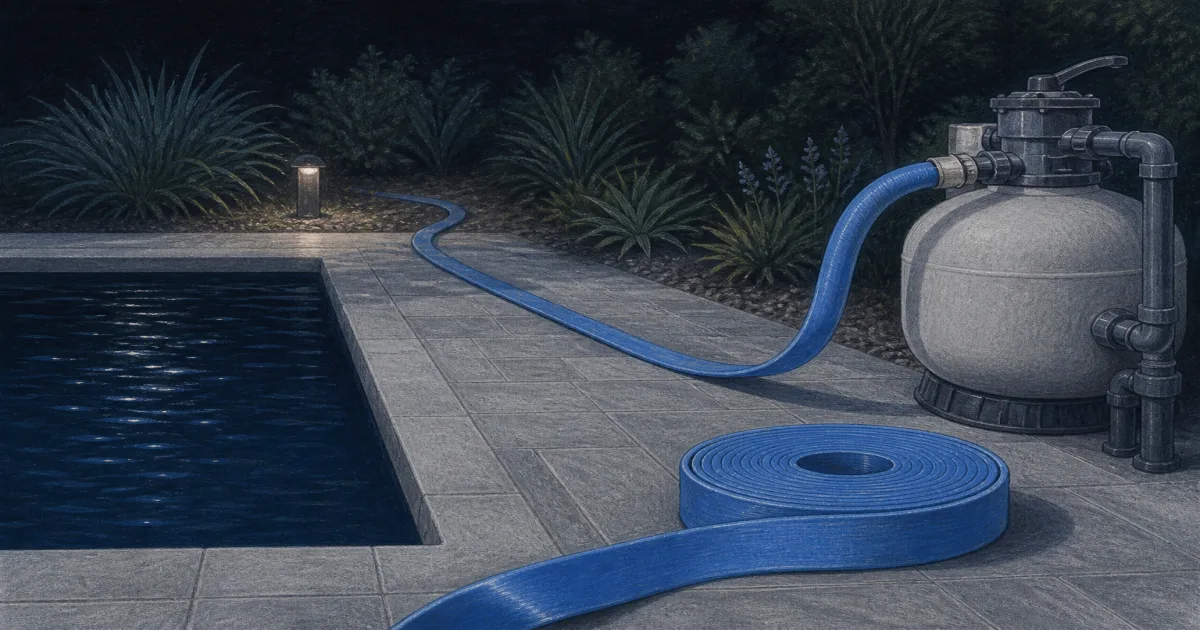
The short answer: A pool backwash hose is a lay-flat discharge line. Measure the waste port, then use the Poolmaster 32170 50-foot hose for most 1.5-inch sand-filter jobs. Step up to the Poolmaster 2-inch 100-foot hose only when the port and the drain path both need it.
Our picks
Backwashing a sand or DE filter sends a burst of dirty water out the waste port. If that water dumps next to the pad, you get a mud ring, a soaked timer, and sometimes a puddle that runs back toward the pool. The hose’s only job is to carry that burst somewhere legal and downhill. It is not a pool vacuum hose. It will not steer a vacuum head.
This recommendation is from live US Amazon listings, labeled sizes, and owner-review patterns. We did not pressure-test these hoses on a lab pump.
Measure the port, then pick a length
Shut the pump off. Read the multiport. The waste opening is usually a 1.5-inch or 2-inch fitting. A 1.5-inch hose stretched over a 2-inch barb will split. A 2-inch hose on a 1.5-inch barb will blow off unless you have the wrong adapter and a lot of hope.
Walk the path you want the water to take. Note fences, window wells, and the neighbor’s mulch. 50 feet is enough for most backyard pads if you can reach a low spot in the lawn. 100 feet is for a long run to a ditch or a far corner. Do not snake the hose uphill and expect it to stay put.
If you have a cartridge filter, you do not need this product. Rinse the element with a garden hose. If you have an above-ground sand filter, you still backwash, and you still need a discharge path. That setup pairs with the sand-filter pumps in our best pool filter guide.
Use the 50-foot hose unless you have a reason not to
Poolmaster 32170 is the practical pool backwash hose for most homes. Fifty feet of lay-flat vinyl, a clamp in the box, and a review history that covers real backwash and drain jobs. Some shipments are 1.5-inch and some are 2-inch depending on stock, so read the variation you are buying and match the port. Warm the coil in the sun if it arrives stiff. Clamp it fully onto the waste fitting before you turn the valve to BACKWASH.
Keep the hose straight. A fold against a sharp valve edge is the usual split. After the cycle, roll it dry and store it out of direct sun. Lay-flat vinyl hates being stored wet in a ball.
The Poolmaster 2-inch by 100-foot hose is the longer, fatter option. Use it when the valve is 2-inch and the discharge point is far away. Buy a 2-inch clamp separately. Do not order it as a “better” 1.5-inch hose. It is a different fit.
Owners who only lower the water level a few inches for winter can use the same hose on WASTE or DRAIN, still clamped, still aimed away from the foundation.
Backwash without flooding the pad
Stand by the valve. Watch the sight glass or the waste stream. When the water runs clear, stop. Long backwash cycles waste water and stir the sand without cleaning more dirt.
Check the pool filter pressure gauge after you return to FILTER. Pressure should drop toward the clean baseline. If it does not, the hose did its job and the media still needs attention.
Never leave the valve on BACKWASH with the pump off and the hose connected as a siphon experiment. Follow the filter manual for the handle sequence.
Run a backwash without drama
- Turn the pump off. Never move a multiport handle under pressure.
- Clamp the hose on the waste port. Lay the hose out straight to the discharge point.
- Set the valve to BACKWASH. Start the pump. Watch the waste stream or sight glass.
- When the water runs clear, stop the pump, set RINSE if your valve has it, run a short rinse, then return to FILTER.
- Restart and confirm pressure dropped. Drain and roll the hose.
DE filters need the manufacturer’s recharge step after a backwash. Sand filters do not get a cartridge rinse. If you are not sure which tank you have, read the label before you buy hose or media.
A split hose is usually a clamp problem or a fold over a sharp thread. Wrap a thin rag on a rough fitting if the vinyl keeps cutting. Replace a hose that already has a pinhole. Tape is a one-day patch, not a season.
If you also vacuum to waste after a storm, the same hose works, still on WASTE, still aimed away from the pool. That is a lot of water. Do not start that cycle if the discharge path is already saturated. Municipal rules on chlorinated discharge vary. When in doubt, send a smaller backwash onto landscaping that can take it, far from wells and storm inlets.
Bottom line
A pool backwash hose moves waste water. It does not vacuum. The Poolmaster 32170 50-foot hose is the right first buy for most 1.5-inch sand and DE valves. Choose the 2-inch 100-foot hose only when the port and the drain path both demand it. Clamp it, lay it straight, and send the dirty water somewhere you are allowed to drain.
Frequently Asked Questions
Is a pool backwash hose the same as a vacuum hose?
No. Vacuum hose is ribbed and holds suction. Backwash hose is thin lay-flat vinyl meant only to dump water. Using vacuum hose for backwash is expensive. Using backwash hose on a vacuum head will collapse.
What diameter do I need?
Measure the waste or backwash port on the multiport valve. Most residential sand filters use 1.5-inch. Some larger valves use 2-inch. Do not assume from a photo.
How long should it be?
Long enough to reach a place you are allowed to discharge, without kinking uphill back into the pool. 50 feet covers most suburban pads. 100 feet is for a distant drain.
Why did the hose split?
Sharp edges on the fitting, a missing clamp, or a hose left baked and folded. Warm a stiff hose in the sun before the first clamp-down, and stretch it out straight before you open the valve.
Can I backwash a cartridge filter?
No. Cartridge tanks get rinsed and soaked. Backwash is for sand and DE filters. See our pool filter cartridge guide if that is your system.
Where can I dump the water?
Follow local rules. Do not send chlorinated backwash into a storm drain or a neighbor’s yard. Many owners run it onto a lawn downhill of the pool, away from the foundation.
Does the 50-foot Poolmaster include a clamp?
The Poolmaster 32170 listing includes a stainless clamp. The 100-foot 2-inch hose listing does not, so buy a clamp that matches that diameter.